How PepsiCo Brought Fairground Can-Knock Physics to Mobile with DC Strike
Written by Adrian K., Founder & Lead Engineer at Codanum
The Context
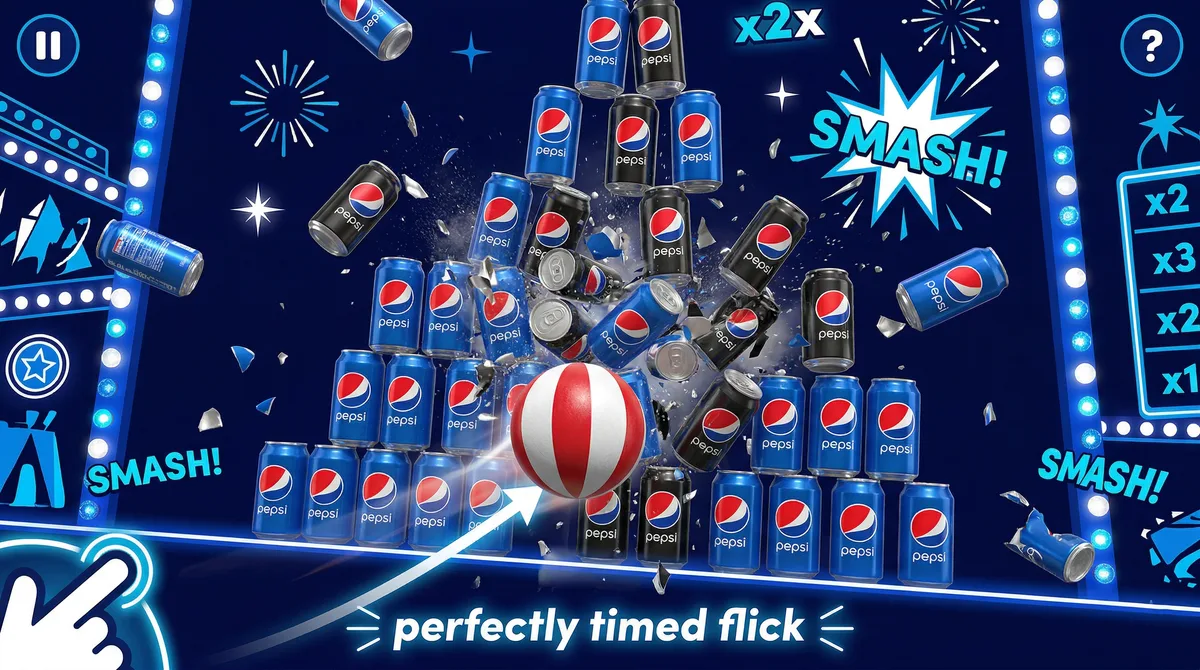
PepsiCo wanted the fairground can-knock game, the one everyone's thrown a ball at, to work on a phone screen without losing what makes it satisfying. That meant a physics-based flick game with branded cans as targets, progressive difficulty, and a global leaderboard to keep the DC campaign's competitive replay going.
The Challenge
Physics-based flick games depend entirely on the satisfaction of the throw. The swipe gesture needed to translate cleanly into believable ball trajectory and momentum, and the can-stack physics had to feel weighty, not floaty or pre-scripted, to deliver the impact the fairground premise promised. Different can arrangements across increasing difficulty levels required a level design system that scaled challenge without resorting to layouts that were simply smaller targets. The global leaderboard needed server-side score validation to block manipulated submissions.
Multi-tier
Can Formations
Rigidbody
Physics
The Solution
DC Strike runs on Rigidbody physics for both ball trajectory and individual can interactions, with a swipe-to-flick input model that reads gesture speed and angle to determine launch velocity, giving skilled players genuine control over arc and spin. Can arrangements across multiple level variants were designed around distinct challenge profiles: wide spreads that reward accuracy, tight towers that punish glancing hits, and mixed formations that require planning the strike line before throwing. A Firebase backend handles global leaderboard ranking with server-side score validation. Impact sound design and slow-motion hit feedback reinforce every clean strike.
The Impact
DC Strike shipped across the PepsiCo DC campaign on time. Playtesters kept calling out how satisfying the flick mechanic felt, with the Rigidbody can physics delivering exactly the tactile impact the brief asked for. Progressive difficulty kept early rounds welcoming while later arrangements gave skilled players a real ceiling to chase, and the global leaderboard turned that into repeat play as people came back to improve their accuracy.
"The can physics alone make it worth playing. There's something deeply satisfying about a perfectly aimed throw toppling the whole stack. That's the moment we wanted every player to feel."