How DealCart and Olper's Turned a Supermarket Aisle into an Endless Runner
Written by Adrian K., Founder & Lead Engineer at Codanum
The Context
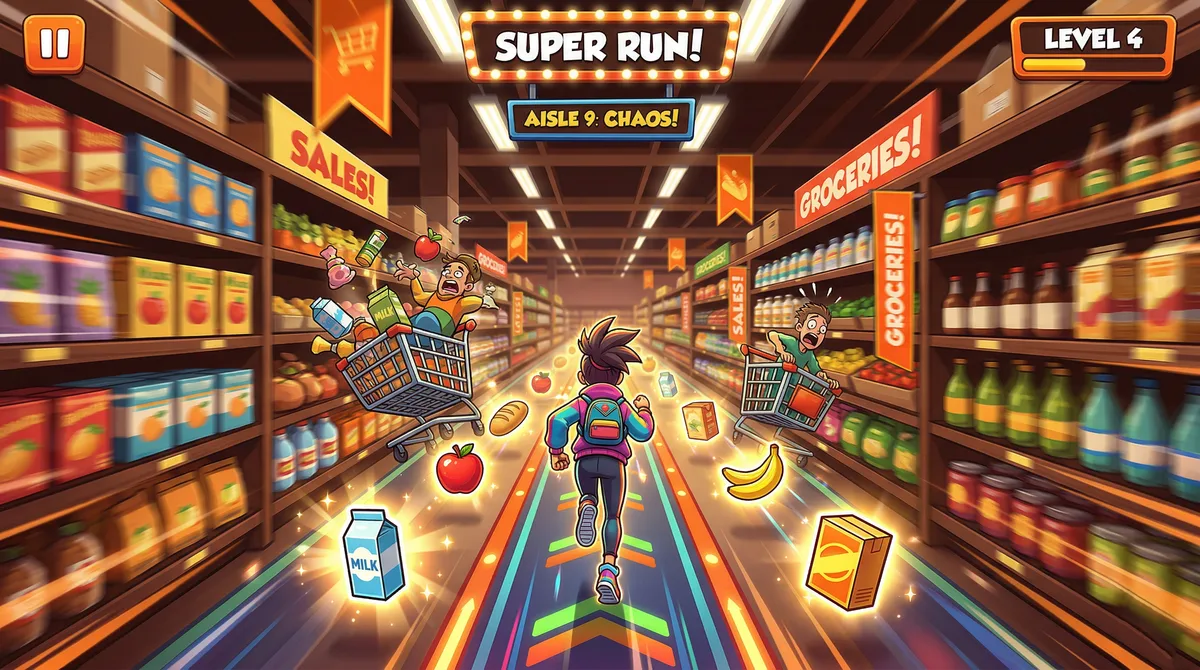
Olper's new product line needed a launch tie-in, and DealCart's grocery platform made a supermarket setting the obvious fit. The idea was an endless runner through busy aisles, dodging carts and shoppers while collecting Olper's products, but only if it worked as a fun game first and an ad second, not the other way around.
The Challenge
Endless runners live or die on the feel of their core loop: the rhythm of collecting, dodging, and surviving. The supermarket setting introduced asset complexity, with six distinct obstacle types (other shoppers, runaway carts, product stands, and others) each needing believable movement patterns and clear visual silhouettes readable in split seconds. The escalating speed curve had to feel like a reward for skill rather than an arbitrary wall, and the dynamic feedback system ("AWESOME!" callouts, combo multipliers, celebratory animations) had to keep energy high without cluttering the running lane.
6
Obstacle Types
Escalating
Difficulty
The Solution
Grocery Run's procedural aisle generation system, built in Unity, tiles environment chunks and scales obstacle frequency and speed as the run extends. Each of the six obstacle categories uses a distinct movement pattern: wandering shoppers drift unpredictably, carts barrel in straight lines, and product displays are static but narrow the lane, among others, training players to read ahead without a tutorial. A combo streak system multiplies score for consecutive item collections, rewarding players who push into tighter gaps. Dynamic feedback text and particle bursts fire on combo milestones, power-up pickups, and near-miss dodges, keeping the run feeling alive. Olper's new product line was illustrated as collectible power-ups distributed across the aisle environment.
The Impact
Grocery Run shipped with the DealCart x Olper's product line campaign as scheduled. Playtest sessions regularly ran past the point where new players expected to fail, a good sign the escalating speed curve felt fair instead of punishing. The combo streak system drove score-chasing, and the Olper's power-ups sat naturally enough in the environment that they didn't read as advertising.
"Grocery Run makes supermarket shopping feel exciting, which is harder than it sounds. The Olper's power-ups fit the world naturally, and the combo system kept us playing longer than we planned to."